
 Business License

Cast versus Fabricated Jaw Crusher Toggle Plate
A jaw crusher toggle bar can be made in two ways, and the choice changes how the part behaves when the machine meets something it cannot crush.
One route casts the bar to shape in a foundry, and the other fabricates it from rolled steel plate.
Both are sold as spares for the same machines, often at similar prices, and the difference becomes visible in service.
This article compares a cast toggle plate with a fabricated toggle plate on strength, failure behaviour, cost and lead time.
1. Casting and Fabrication: Two Routes to a Toggle Plate
Both routes begin with a drawing and end with a bar whose ends are machined to fit the seat recesses.
What happens between those two points is quite different, and that is where the behaviour of the finished part is decided.
Casting begins with a pattern.
The pattern is packed in sand, the mould is closed, and molten metal is poured into the cavity.
After cooling and shakeout the bar is cleaned, heat treated if required, and its ends are machined.
Fabrication begins with a plate.
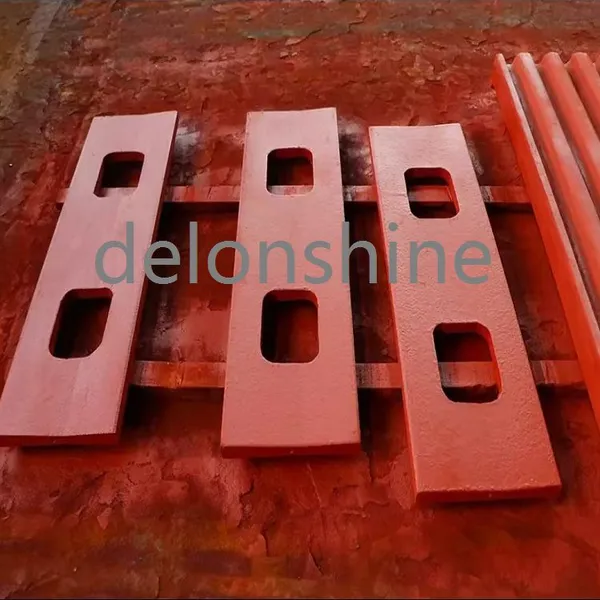
A section of rolled alloy steel is cut to length and width, and the ends are then profiled and machined to the seat radius.
Holes, notches and clamp features are added by machining rather than formed during the pour.
The table below sets out the main production differences between the two routes.
| Step | Cast bar | Fabricated bar |
|---|---|---|
| Tooling | pattern and core boxes | no pattern required |
| Forming | molten metal fills a mould | rolled plate is cut and machined |
| Lead time driver | pattern work and foundry schedule | plate supply and machining |
| Shape freedom | integral waist and notch are easy | features must be machined |
| Records | casting and heat treatment sheets | mill certificate and machining report |
2. How a Cast Toggle Plate Is Produced
A cast toggle plate is produced by pouring molten metal into a sand mould formed around a pattern.
The metal is usually a manganese steel or a ductile iron, and the grade is chosen for the behaviour wanted under overload.
Section thickness is controlled by the mould rather than by a rolling mill, so a tapered or waisted profile is easy to include.
Cooling is the step that decides quality.
Thick sections cool more slowly than thin ones, and that difference can leave shrinkage porosity inside the bar when the feeder design is poor.
A sound casting shows a uniform structure across the fracture face, while a part with internal porosity may break at a load well below its design figure.
Heat treatment follows shakeout.
Manganese castings are usually supplied in the solution treated condition, held for 2 to 4 hours at temperature, and ductile iron grades are normalised to a specified tensile strength and elongation.
Delonshine Technology records the heat number and the test figures for every batch.
Machining is limited to the ends and any mounting features.
Because the profile arrives close to final shape, machining time is short and the cost of the pattern is spread across the batch.
3. How a Fabricated Toggle Plate Is Made
A fabricated toggle plate starts as a plate cut from rolled alloy steel, commonly a chromium molybdenum grade supplied with a mill certificate and a carbon level near 0.4 percent.
Rolled plate carries consistent properties through its thickness, which removes the risk of the internal shrinkage that a casting can hold.
The trade-off is that the profile is limited to what can be cut and machined from flat stock.
Cutting is done by flame, plasma or water jet, depending on thickness.
Cut edges are then machined or ground, because a flame cut edge carries a heat affected zone that behaves differently from the parent plate.
End radii are turned or milled to match the seat recess and checked against a template.
Heat treatment may follow machining.
A quench and temper cycle raises yield strength and hardness, and the tempering temperature sets the balance between the two.
Because the part is cut from plate rather than poured, the same treatment can be repeated across batches with little variation.
Fabrication suits short runs and unusual lengths.
A plant that needs three bars for an older machine can have them cut and machined without paying for a pattern.
That flexibility is the main reason a fabricated toggle plate appears in markets where machine populations are mixed.
4. Cast and Fabricated Toggle Plate: Strength and Failure Behaviour
Strength figures are easy to compare on paper and harder to compare in a crusher.
A cast manganese bar work hardens under repeated impact, so its surface hardness commonly moves from about 200 HB to 350 HB in service and its resistance to wear improves with the duty it sees.
A rolled alloy bar is supplied at roughly 300 HB and stays at that figure throughout its life.
Failure behaviour separates the two more clearly.
A cast toggle plate made to a sacrificial specification will yield or break at a designed load, which is what protects the pitman and the frame.
A fabricated bar with a high yield strength may carry the overload instead of releasing it, and the damage then moves to the next component in the drive train.
That does not make fabrication the weaker choice.
Where a plant wants a predictable release point, a fabricated bar machined with a reduced waist gives a more consistent result than a casting whose properties vary with section thickness.
The right answer depends on what the machine was designed to sacrifice.
The table below compares the two on the properties that matter at the crusher.
| Property | Cast bar | Fabricated bar |
|---|---|---|
| Surface hardness in service | rises with impact | constant from the first stroke |
| Internal soundness | depends on foundry practice | consistent through thickness |
| Failure control | set by grade and section | set by machining and tempering |
| Shape options | integral waist and notch | machined features |
| Field repair | welding changes the behaviour | parent material is known |
Shenyang Delonshine Technology Co Ltd supplies both routes, so a customer is not pushed toward whichever part happens to sit on the shelf.
5. Toggle Plate Material Selection for Different Crushers
Toggle plate material selection starts with the machine rather than with the price list.
Machine size, seat geometry, feed type and the cost of an unplanned stop all point toward one route or the other.
Large primary crushers in hard rock mines usually carry a cast bar.
The sections are heavy, commonly between 80 and 150 millimetres thick, the tramp metal risk is real, and the ability to build a reduced waist into the mould makes casting the practical choice.
The pattern cost is recovered quickly across a fleet that shares one machine model.
Smaller machines, older models and mixed fleets often suit fabrication.
A pattern for a machine built in small numbers may never pay back, whereas a plate can be cut and machined to any length.
Plants that keep a spare on the shelf also value the shorter processing route.
The table below maps common situations to a starting recommendation.
| Situation | Starting route | Reason |
|---|---|---|
| High tramp metal risk | cast | sacrificial grade with designed failure |
| Mixed machine fleet | fabricated | no pattern cost per model |
| Unusual bar length | fabricated | rolled plate comes in long lengths |
| Large batch of one model | cast | pattern cost spread across the batch |
| Single urgent spare | fabricated | shorter processing route |
Shenyang Delonshine Technology Co Ltd asks for the worn bar or its measurements before confirming toggle plate material selection for a machine.
6. Cost and Lead Time of a Cast Toggle Plate
Cost comparison between the two routes is not a simple price per kilogram.
A cast toggle plate carries a pattern cost paid once, normally recovered across 3 or 4 bars, then a lower unit cost that falls as the batch grows.
A fabricated bar carries no pattern cost but a higher material cost for thick plate, plus machining time that scales with the section.
Lead time follows the same pattern.
Casting includes pattern making, moulding, pouring, cooling, heat treatment and machining, and the cooling step cannot be hurried.
Fabrication includes plate supply, cutting, machining and any heat treatment, and the total is usually shorter for a small quantity.
Freight and packing are similar for both, because the part is compact and heavy in either case.
Bars travel in timber cases with protected machined ends, and a mixed consignment of jaw plates, cheek plates and toggles packs efficiently in one crate.
The table below lists the cost drivers a buyer can influence.
| Driver | Effect on price |
|---|---|
| Batch quantity | lowers unit cost for castings |
| Pattern availability | avoids a new pattern charge |
| Plate thickness | raises material cost for fabricated bars |
| Machining complexity | raises cost for notches and radii |
| Required date | favours fabrication for urgent small orders |
7. Wear, Fitting and Replacement of the Toggle Plate
Wear on a toggle bar comes from seating and load rather than from abrasion, because the part never touches rock.
What wears is the end radius and the seat recess, and the rate depends on how well the two match.
A bar that sits properly lasts far longer than one that rocks in a worn seat.
Fitting is the same for both routes with one difference.
A cast bar goes in with its machined ends checked against the recess, and the tension rod is set to the figure in the manual.
A fabricated bar is checked the same way, but the rolled surface marks more easily, so care with slings and wedges pays off.
Replacement planning benefits from a simple record.
Recording the fitting date, the measured seat length and the closed side setting lets a planner predict the next change instead of reacting to it.
Delonshine keeps those figures on file so a repeat order arrives with the same critical dimensions as the last one.
The table below summarises what to check at each inspection.
| Check | What to look for |
|---|---|
| End radius | flattening or pitting at the seat |
| Mid section | a bow that shows the bar has yielded |
| Fracture face | a smooth patch that points to a casting defect |
| Seat recess | wear deep enough to let the bar rock |
| Retention | correct tension rod setting and clamp fit |
8. Matching Cast or Fabricated Toggle Plate to the Duty
The decision comes down to four questions.
How many machines of this model does the plant run, how severe is the tramp metal risk, how quickly is a spare needed, and what is the machine designed to sacrifice.
A fleet of identical primary crushers points toward a cast toggle plate.
One pattern serves many machines, the unit cost falls as quantity rises, and the sacrificial behaviour can be controlled through the grade and the section.
A plant with a single older crusher and no pattern on file points toward a fabricated toggle plate.
A third option deserves a mention.
Some suppliers offer a forged bar for the heaviest duty, where a rolled and forged section gives the highest resistance to yielding.
That route suits machines with a hydraulic release or a metal detector upstream, where the toggle is not expected to be the sacrificial item.
Delonshine Technology discusses all three routes with the customer and treats toggle plate material selection as a question about duty rather than about a catalogue default.
9. Frequently Asked Questions about Toggle Plate Material Selection
9.1 Is a cast bar stronger than a fabricated one?
Strength is not the deciding difference between the two. A cast manganese bar work hardens under impact and can reach a high surface hardness in service, while a rolled alloy bar starts strong and stays at that level. In a crusher, the more useful question is which one fails in the way the machine was designed to fail. A bar that is too strong moves the overload to the pitman or the eccentric shaft, which costs far more to repair than a toggle bar does, and that is the outcome sound toggle plate material selection is meant to avoid.
9.2 Which route gives the shorter lead time?
For a small quantity, fabrication is usually quicker, because the processing route is short and no pattern has to be made first. Casting adds pattern making, moulding, pouring, cooling and heat treatment before machining begins, and the cooling stage sets a floor that cannot be compressed. Where a pattern already exists in the foundry, the gap narrows and a cast bar can be produced quickly against that stock pattern. The practical rule is to ask the supplier which route is available now rather than which route is theoretically faster.
9.3 Can a fabricated bar replace a cast part in the same machine?
It can, but the change should be deliberate and recorded. A fabricated bar has different failure behaviour, so substituting one changes what the machine sacrifices under overload. Where the machine has a hydraulic release or an upstream metal detector, the risk is lower. Where the toggle is the main protection, a substitution should be confirmed with a stress calculation rather than decided on price, and a note in the machine history keeps the next maintenance team informed and prevents the change from being quietly reversed at the next rebuild.
9.4 What should an enquiry include for either type?
Send the machine model and serial number, the measured length between seat centres, the original drawing or pattern number if one exists, the grade or the behaviour required, and photographs of the worn bar. Those five items let a supplier quote a part that fits and behaves as intended. Adding the quantity and the required date lets the supplier choose between the casting and fabrication routes and quote a realistic lead time for the order. Where a pattern already exists, quoting from the pattern number can save several days of drawing work.
Recently Posted
-
Jaw Crusher Plate Casting Defects and How to Spot Them
September 30, 2026A jaw plate that fails after three weeks instead of three months usually carries the explanation on its surface from the day it wa Read More
 -
Regional Buying Practice for Mining Spare Parts Across Export Markets
September 30, 2026A foundry that exports to a dozen regions learns quickly that the same casting is bought in quite different ways from one market t Read More
 -
Heat Treatment Options for Crusher Wear Parts
September 30, 2026Two castings can leave the same foundry with the same chemistry and behave quite differently in service, and the reason is almost Read More
 -
Crusher Wear Parts Overview: Plates, Liners, Mantles and Toggles
September 29, 2026A plant that budgets for crusher wear parts as a single line item usually discovers later that the parts inside one machine fail a Read More

Contact Us
Recommended Products
-
 Vertical Mill Reducer Planetary Gear AssemblyNegotiableMOQ: 2 Combos
 -
High Precision Mining Equipment End Cover Wear Resistant Crusher End CapNegotiableMOQ: 2 Pieces
-
Heavy Duty Mining Equipment Cast HousingNegotiableMOQ: 2 Pieces
-
Mining Parts Concave MantleNegotiableMOQ: 2 Pieces
-
High Strength Cast Steel Crusher Lifting Beam Heavy Load Mining Equipment Spare PartNegotiableMOQ: 2 Pieces
-
OEM Replacement Mining Spare Parts for Stone Crushing PlantNegotiableMOQ: 2 Pieces
-
Cast Steel Ball Mill Head for Mineral ProcessingNegotiableMOQ: 2 Pieces
-
Large Diameter Cast Gear for Ore Grinding MillNegotiableMOQ: 2 Pieces
-
Wear Resistant Mining Spare PartsNegotiableMOQ: 2 Pieces
-
Industrial Wet Dry Ball Mill for Mineral ProcessingNegotiableMOQ: 2 Pieces


-
High Wear Resistant Ball Mill Wear Parts Ball Mill Gear Pinion Liner for Mining Processing PlantNegotiableMOQ: 2 Pieces
-
Heavy Duty Equipment CasingNegotiableMOQ: 2 Pieces
-
Customized Main Shaft for Cone CrusherNegotiableMOQ: 2 Pieces
-
Ball Mill Head With Flange and Bolt HolesNegotiableMOQ: 2 Pieces
-
Heavy Duty Equipment CasingNegotiableMOQ: 2 Pieces


-
Crusher Wear Parts for Mining MachineryNegotiableMOQ: 2 Pieces
-
High Manganese Steel Jaw Crusher Fixed & Swing PlatesNegotiableMOQ: 2 Pieces
-
Cast Steel Safety Toggle Plate for Jaw Crusher Overload ProtectionNegotiableMOQ: 2 Pieces
-
High Manganese Steel Mill LinerNegotiableMOQ: 2 Pieces
-
Main Shaft Steel Sleeve Lock Nut for Cone CrusherNegotiableMOQ: 2 Pieces