
 Business License

Cast or Forged: Choosing the Material for a Mining Big Gear
Two mills of similar size can carry rings made by two different processes, and neither owner is making a mistake.
A cast steel big gear and a forged steel girth gear are both sound engineering answers, and the choice between them follows from diameter, tooth load, quantity, and schedule.
What causes trouble is choosing by habit or by price alone, because the two routes differ in ways that appear after several years in service.
This article compares the two manufacturing routes, explains how a big gear material grade is written into a specification, and sets out the casting and forging practice that sits behind each option.
It also covers heat treatment, cost, and lead time, so the choice can be made on the whole picture rather than on one line of a quotation.
1. Cast versus Forged: Two Routes to a Mining Big Gear
A cast steel big gear begins as liquid metal poured into a mould shaped like the finished ring.
A forged steel girth gear begins as an ingot or a billet that is worked under pressure until it takes the shape of a ring, with the fibre of the metal following the circumference.
Both routes end with a machined toothed ring, and both can meet the same dimensional standard.
The difference lies in the internal structure each route produces.
Casting builds a component from the outside in, so the last metal to solidify tends to sit near the centre of the section.
Forging works the metal in the solid state, which closes internal voids and refines the grain along the direction of flow.
The table sets out the practical consequences of that difference.
| Item | Cast route | Forged route |
|---|---|---|
| Typical use | large diameter rings in small batches | rings with the heaviest tooth loads |
| Internal soundness | depends on riser and feeding design | improved by the working pass |
| Grain flow | uniform in all directions | aligned with the circumference |
| Tooling cost | pattern and mould cost per design | dies and ring mill time |
| Practical size ceiling | set by furnace and pouring capacity | set by press or ring mill capacity |
| Lead time driver | pattern making and foundry slot | forging slot and machining |
2. When a Cast Steel Big Gear Is the Right Choice
A cast steel big gear suits a ring that is large in diameter and needed in ones or twos.
Rings beyond roughly 8 metres outside diameter are normally cast, because the tooling for the alternative route becomes impractical at that scale.
Casting also allows a hollow section, a stiffening rib, or a split joint to be formed in the same pour, which removes machining operations later.
The process rewards a foundry that controls feeding and solidification.
A heavy rim section holds heat longer than a thin web, and the temperature difference during cooling is what produces shrinkage porosity if the risers are sized badly.
Ultrasonic testing of the rim and the web is therefore part of normal acceptance for a cast steel big gear, not an extra service.
Casting also makes repair and renewal easier.
A ring that is cast in two halves can be replaced one half at a time where the crane capacity makes a full ring impractical.
Shenyang Delonshine Technology casts rings of this type in a foundry equipped with a 20 tonne electric arc furnace and 7 to 10 tonne induction furnaces, with a single piece ceiling of roughly 100 tonnes.
3. When a Forged Steel Girth Gear Wins on Duty
A forged steel girth gear comes into its own where the tooth load is high and the rim section is relatively compact.
The working pass aligns the grain with the circumference, which raises fatigue strength in exactly the direction the teeth are loaded.
For a drive that runs at high specific power on a ring of moderate diameter, that gain in fatigue performance is worth the extra cost.
Forging also reduces the scatter in properties across a large section.
A cast section can vary in strength from the surface to the centre, while a forged ring is more uniform once it has been quenched and tempered.
Designers who work with a narrow safety margin tend to prefer that predictability, particularly where the calculation is dominated by tooth root bending stress.
The limits of the route are just as clear.
Forging capacity sets a ceiling on diameter and weight, and the cost per tonne rises sharply once a ring approaches that ceiling.
For a very large mill, a forged steel girth gear may simply not be available at the required size, which settles the question before any comparison of price begins.
4. How Big Gear Material Grade Is Specified
A big gear material grade has to state both the chemistry family and the mechanical properties the finished ring must reach.
Quoting a grade name alone leaves too much open, because two foundries can pour the same designation and deliver different hardness and toughness after heat treatment.
The specification should therefore pair the grade with tensile strength, impact energy, and surface hardness.
For rings in the quenched and tempered family, a common choice is a chromium-molybdenum steel such as 42CrMo or its equivalent.
That grade balances hardenability with toughness and machines well after tempering, which suits a large toothed component.
Nickel-bearing grades are chosen where the section is very thick or where low temperature toughness matters.
The table gives the figures that belong on a specification for a big gear material grade.
| Property | Typical requirement | Why it is stated |
|---|---|---|
| Chemistry family | 42CrMo or equivalent | fixes hardenability and toughness balance |
| Tensile strength | 800 to 1,000 MPa | sets the load the rim can carry |
| Yield strength | at least 600 MPa | limits plastic deformation at the root |
| Impact energy | roughly 30 J at room temperature | resists shock and start-up load |
| Flank hardness | 300 to 350 HB | controls pitting resistance |
| Core hardness | 240 to 300 HB | keeps the tooth root tough |
Testing requirements belong next to the figures.
A specification that asks for a test certificate without naming the sampling position invites a certificate that describes a test block rather than the ring.
A better wording names the position on the rim, the direction of the test piece, and the frequency of testing during production.
5. Casting Practice Behind a Cast Steel Big Gear
Casting a ring of this size is a sequence of controlled steps rather than a single pour.
Pattern making comes first, followed by moulding and core setting, then melting and chemistry adjustment, then pouring at a controlled temperature, and finally a slow cool under an insulating cover.
Skipping the slow cool is one of the most common causes of residual stress that appears later as a crack.
Feeding design decides whether the ring is sound.
Risers have to stay liquid long enough to feed the heavy rim as it contracts, and chills are placed to speed solidification in the sections that would otherwise stay soft.
A foundry that keeps records of pour temperature and cooling time can repeat a good result, which matters when a second ring is ordered years later.
Cleaning and inspection follow the shakeout.
Risers and gates are removed, the surface is dressed, and the ring is checked dimensionally before heat treatment.
Internal examination by ultrasonic testing then confirms that the feeding worked, and the result is filed against the ring number for traceability.
6. Forging and Rolling for a Forged Steel Girth Gear
Forging a ring starts with an ingot or a continuous cast billet that has been cut to weight.
The piece is heated to a working temperature, upset and pierced, and then expanded on a ring mill until the diameter and the section are close to the finished size.
Every pass refines the grain and closes the internal discontinuities left by the original casting.
Temperature control governs the result.
Working the metal below the correct range can produce internal cracking, while working it above the range coarsens the grain and reduces toughness.
A forge shop therefore logs furnace temperature and the time at temperature for each piece, and that record travels with the finished ring.
Machining a forged steel girth gear is usually the longest single step in the schedule.
A ring of several metres diameter has to be set up so that the tooth circle, the bore, and the joint faces share one reference.
That setup is more demanding than the equivalent operation on a casting, because the forged ring is stiffer and less likely to spring during clamping.
7. Heat Treatment and Hardness Control on a Cast Steel Big Gear
Heat treatment is where a sound casting becomes a durable component, and it is also where shortcuts show up years later.
A normalising and tempering cycle relieves casting stress and produces a uniform structure across a heavy section.
A quench and temper cycle goes further, raising strength at the cost of a more demanding process window.
Tooth flanks then receive a local hardening treatment.
Induction or flame hardening produces a case that resists pitting while the core of the tooth remains tough enough for bending load.
Case depth is specified as a range rather than a single figure, because a case that is too shallow spalls and a case that is too deep leaves a weak root.
Hardness testing confirms the result at several points.
The usual pattern is a reading on each flank of a sample of teeth, a reading near the joint, and a set of readings on the rim face.
Delonshine Technology records those readings on the inspection report that travels with each cast steel big gear, so the buyer can compare delivery against specification without arranging a separate test.
8. Cost and Lead Time Compared for Cast and Forged Steel
Cost and lead time follow from the process rather than from the region.
For a single large ring, the casting route usually carries the lower total cost, because the pattern is a modest investment next to a forging programme.
For a small ring with a heavy tooth load, the balance can shift toward forged steel, since the material gain allows a lighter section and less machining.
Lead time has two parts to it.
On the cast route, the long item is often the pattern and the foundry slot, with machining adding a further block of weeks.
On the forged route, the long item is the forging slot, followed by a machining cycle that is harder to compress.
Neither route tolerates an order placed late.
A plant that orders a replacement ring when the current one has reached its wear limit is already behind schedule, because transport adds weeks on top of production.
The cheaper habit is to order against a measured wear trend, with the order issued when the remaining life is estimated at one full production cycle.
Shenyang Delonshine Technology works to that kind of plan with regular customers, because a ring booked against a wear forecast is easier to schedule than one ordered after a failure.
9. Big Gear Material Grade: Questions Buyers Ask
These are the questions that come up when a plant is preparing a ring enquiry.
9.1 Is a forged ring always stronger than a cast ring?
Not in every respect. Forging improves fatigue strength and internal soundness in the direction of grain flow, and that is a real advantage where tooth root bending stress governs the design. A well made casting can match a forging on static strength and on flank hardness once both have been heat treated properly, and casting allows shapes that forging cannot produce at the same diameter. The fair comparison is between two properly executed processes, and for most large mill rings the deciding factor is availability at the required size rather than an intrinsic property gap.
9.2 What big gear material grade should I specify for a 42CrMo ring?
Specify 42CrMo or an equivalent chromium-molybdenum grade, and write the mechanical properties alongside it. Ask for tensile strength in the region of 800 to 1,000 megapascals, a yield strength of at least 600 megapascals, and flank hardness between 300 and 350 HB. Add an impact energy requirement if the mill sees frequent starts under load. Naming the grade without the properties and the sampling position leaves the supplier room to interpret the requirement, and interpretation is what produces a ring that meets the certificate and disappoints in service.
9.3 How long does it take to make a replacement mining big gear?
Timing depends on the route and on how busy the foundry or forge shop is. On the cast route, a large ring typically needs several weeks for pattern and mould work, followed by casting, cooling, heat treatment, and a machining cycle measured in further weeks. A forged steel girth gear adds the forging slot to that sequence and usually finishes later unless the ring is small enough to be rolled quickly. The practical answer for a plant is to place the order against a wear trend rather than against a failure, so the schedule has room to absorb the normal delays.
9.4 Can a worn ring be re-profiled instead of replaced?
Re-profiling is worth considering where the damage is confined to the flank and the tooth root is intact. The ring is removed, stress relieved if the history justifies it, and the flanks are re-cut to the original profile, which reduces the tooth thickness slightly. That reduction has to be checked against the remaining bending capacity of the tooth before the work is approved. Delonshine advises a dimensional survey and a magnetic particle test before re-profiling, because a root crack found afterwards turns a planned saving into a scrapped ring.
Recently Posted
-
Mining Big Gear Basics: How a Large Girth Gear Drives a Grinding Mill
September 24, 2026A grinding mill turns because its ring gear turns with it. That ring, bolted around the shell, collects the torque produced by the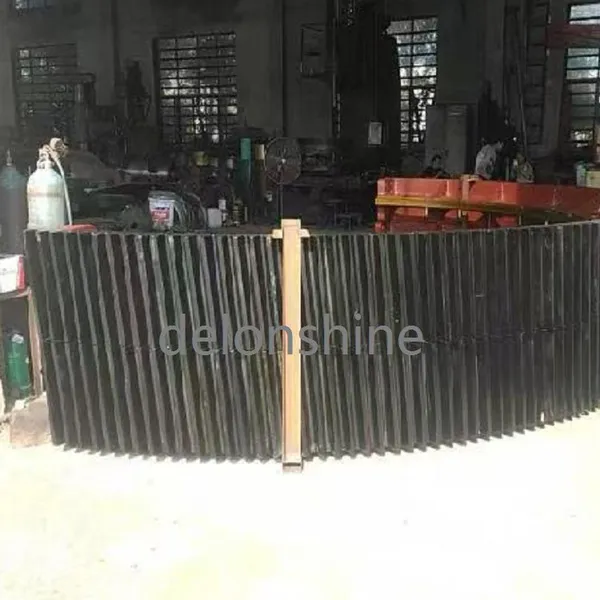 Read More
 -
Repair and Refurbishment of Large Mining Equipment End Covers
September 24, 2026A large end cover can weigh several tonnes and cost as much as a small machine, so the decision to replace one deserves more thoug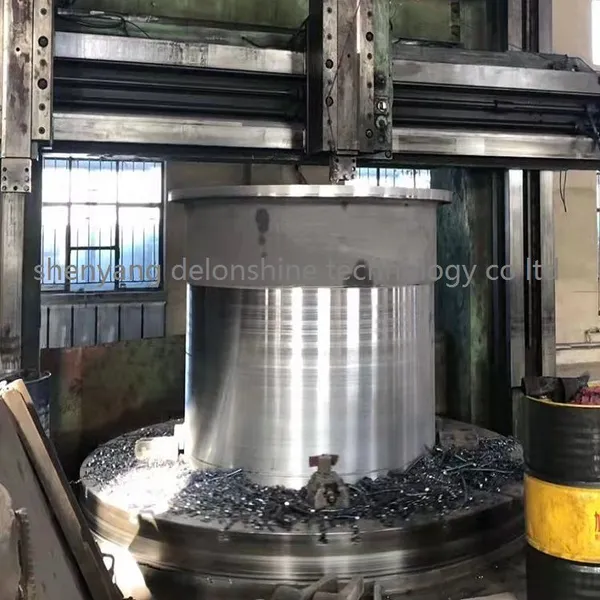 Read More
 -
Lead Time Planning for Jaw Crusher Toggle Plates
September 23, 2026A toggle plate is a small casting against the weight of a jaw crusher, and that is exactly why it is easy to leave out of the purc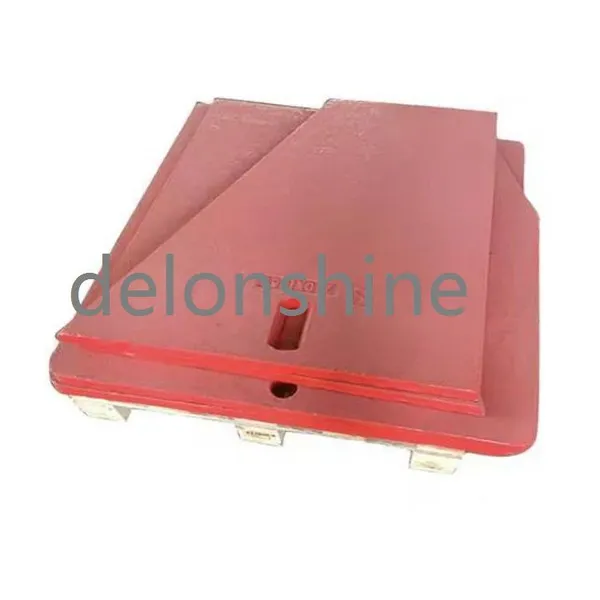 Read More
 -
Mining Equipment End Covers for Mobile and Semi-Mobile Plants
September 23, 2026A mobile crushing plant moves, and every heavy casting inside it has to survive that movement as well as the duty it was designed
Read More

Contact Us
Recommended Products
-
 Vertical Mill Reducer Planetary Gear AssemblyNegotiableMOQ: 2 Combos
 -
High Precision Mining Equipment End Cover Wear Resistant Crusher End CapNegotiableMOQ: 2 Pieces
-
Heavy Duty Mining Equipment Cast HousingNegotiableMOQ: 2 Pieces
-
Mining Parts Concave MantleNegotiableMOQ: 2 Pieces
-
High Strength Cast Steel Crusher Lifting Beam Heavy Load Mining Equipment Spare PartNegotiableMOQ: 2 Pieces
-
OEM Replacement Mining Spare Parts for Stone Crushing PlantNegotiableMOQ: 2 Pieces
-
Cast Steel Ball Mill Head for Mineral ProcessingNegotiableMOQ: 2 Pieces
-
Large Diameter Cast Gear for Ore Grinding MillNegotiableMOQ: 2 Pieces
-
Wear Resistant Mining Spare PartsNegotiableMOQ: 2 Pieces
-
Industrial Wet Dry Ball Mill for Mineral ProcessingNegotiableMOQ: 2 Pieces


-
High Wear Resistant Ball Mill Wear Parts Ball Mill Gear Pinion Liner for Mining Processing PlantNegotiableMOQ: 2 Pieces
-
Heavy Duty Equipment CasingNegotiableMOQ: 2 Pieces
-
Customized Main Shaft for Cone CrusherNegotiableMOQ: 2 Pieces
-
Ball Mill Head With Flange and Bolt HolesNegotiableMOQ: 2 Pieces
-
Heavy Duty Equipment CasingNegotiableMOQ: 2 Pieces


-
Crusher Wear Parts for Mining MachineryNegotiableMOQ: 2 Pieces
-
High Manganese Steel Jaw Crusher Fixed & Swing PlatesNegotiableMOQ: 2 Pieces
-
Cast Steel Safety Toggle Plate for Jaw Crusher Overload ProtectionNegotiableMOQ: 2 Pieces
-
High Manganese Steel Mill LinerNegotiableMOQ: 2 Pieces
-
Main Shaft Steel Sleeve Lock Nut for Cone CrusherNegotiableMOQ: 2 Pieces