
 Business License
Blog Categories

Lock Nuts and Sleeves on Grinding Mill Assemblies
A mill trunnion lock nut and a grinding mill sleeve sit at the two ends of the same problem: a rotating machine that has to hold a heavy load while it is bathed in abrasive slurry.
At a copper concentrator a trunnion seal was replaced three times in a year, and the wear was traced to a lock nut that had been reused until its thread no longer held the setting.
The seal was the symptom and the fastener was the cause, which is a pattern that repeats on mills more often than the maintenance record suggests.
This article follows the fasteners and sleeves on a grinding mill from the trunnion to the shell, and it explains where each one fails and what a plant should check before a reline.
1. Lock Nuts and Sleeves on Grinding Mill Assemblies
A grinding mill is held together by a small number of large fasteners, and the lock nuts and sleeves among them do specific jobs rather than generic ones.
A mill liner bolt lock nut clamps a liner to the shell, so its job is to hold a preload against continuous vibration and impact from the charge.
A mill trunnion lock nut holds a rotating assembly in position on the trunnion, so its job is to keep an axial setting that a seal depends on.
And a grinding mill sleeve protects a shaft or a trunnion surface from the wear and the corrosion that would otherwise reach the component it wraps.
The three parts are grouped here because they fail in related ways, and because a plant that stocks them together tends to replace them on a schedule rather than after a leak.
2. The Mill Trunnion Lock Nut and the Trunnion Seal
A mill trunnion lock nut sets the axial position of a component on the trunnion, and the seal that runs against it is no better than that setting.
The nut is large, usually between M36 and M60 on a ball mill, and it is tightened to a figure that is high enough to hold the setting under full load.
A nut that has lost its preload allows the assembly to move by a fraction of a millimetre, and that movement is enough to open the seal face.
Slurry then reaches the sealing surface, and the leak that follows is reported as a seal failure rather than as a fastener failure.
Two signs point back to the nut.
Seal life that shortens with each replacement, because the seating surface is moving a little more each time.
And a nut that can be turned with a spanner after the mill has been in service, which means the preload was lost rather than never applied.
On a large mill the tightening figure is usually in the range of 1800 to 3600 newton metres, applied with a hydraulic tool rather than a manual wrench.
Shenyang Delonshine Technology supplies a mill trunnion lock nut to the drawing and the grade, and it records the thread class so the replacement matches the trunnion that is on the machine.
3. Grinding Mill Sleeve Wear in the Feed End
A grinding mill sleeve wears most rapidly at the feed end, because that is where the material enters and where the slurry is at its most abrasive.
The feed end of a mill carries a higher proportion of coarse, sharp particles, and those particles reach the sleeve before the grinding action has rounded them.
The result is a wear pattern that is heavier on the feed side than on the discharge side, and a sleeve that is replaced on a symmetric schedule will be changed either too early or too late depending on which end it sits.
Measuring the sleeve at the feed end and at the discharge end as two separate items gives a plant a realistic life for each.
Three factors set the wear rate on a grinding mill sleeve.
The solids concentration of the slurry, since a thicker pulp carries more abrasive material past the surface.
The particle size at that point, since coarse feed cuts faster than fine product.
And the sleeve material, where a hardened steel or a coated surface extends life in proportion to its hardness.
Sleeve thickness is commonly measured in the range of 20 to 40 millimetres, and a loss of more than about 50 per cent of that section is the point at which a replacement is scheduled.
4. Mill Liner Bolt Lock Nut Torque and Reuse
A mill liner bolt lock nut is the most numerous fastener on a mill, and it is also the one most often reused beyond its limit.
Each liner bolt is tensioned to a specified torque, and the lock nut holds that tension against the vibration of a mill turning at 12 to 18 revolutions per minute.
A used nut has already been stretched and its thread has already been worked, so a second and third use reduces the preload it can hold.
Most mills allow a nut to be reused two or three times at most, and some operators replace the set at every reline because the cost is small against the downtime.
A mill turning at 12 to 18 revolutions per minute works that joint about a million times a year, which is what eventually releases a reused nut.
Two practices extend the life of the joint.
A thread lubricant applied to the stud and the nut, which stabilises the friction so that the applied torque produces a predictable tension.
And a torque pattern that works from the centre of a liner outward, which seats the plate before the final pass rather than after it.
Delonshine Technology supplies mill liner bolt lock nuts as a set with the bolts, so a reline does not mix new studs with worn nuts.
5. Where a Grinding Mill Sleeve Fails and Why
A grinding mill sleeve fails in three ways, and each one leaves a different mark on the surface.
Abrasion removes material evenly and thins the sleeve, which is the slow failure that a thickness measurement catches in time.
Corrosion attacks a sleeve that sits in a stagnant zone, and the pitting it leaves concentrates stress at the base of each pit.
And fretting occurs where a sleeve is loose on its shaft, so the two surfaces rub and the sleeve loses material from its inside face rather than its outside.
The failure mode decides the fix.
A worn sleeve is replaced with a harder or thicker one.
A corroded sleeve points to the material rather than the thickness, and a corrosion resistant grade is the answer.
And a fretted sleeve points to the fit, which is a machining tolerance problem rather than a material problem.
6. The Mill Trunnion Lock Nut on a Ball Mill versus a SAG Mill
The mill trunnion lock nut sees a different duty on a ball mill than on a SAG mill, and the difference comes from the load the mill carries.
A SAG mill handles larger feed and a heavier charge, so its trunnion fasteners see more impact and a wider variation in load.
A ball mill runs a more uniform charge, so its fasteners see a steadier load but a higher number of cycles.
That distinction changes the grade and the tightening figure rather than the design, and it is one reason a nut from one mill type should not be fitted to the other.
The table below sets out the contrast.
| Factor | Ball mill | SAG mill |
|---|---|---|
| Charge | steel balls, uniform | mixed ore and balls |
| Load pattern | steady, high cycle count | variable, higher impact |
| Fastener grade | high strength steel | tougher grade for impact |
| Main check | preload retention | thread condition |
A plant that runs both mill types should keep the two nut sets separate, because a mixed bin is a mixed specification.
7. Mill Liner Bolt Lock Nut Inspection Between Relines
A mill liner bolt lock nut can be inspected while the mill is running, and a short check between relines catches most of the problems that would otherwise appear as a loose liner.
A torque check on a sample of nuts against the specified figure confirms that the preload is holding.
A visual check for a nut that has backed off, a stud that has stretched or a washer that has deformed comes next.
And a check for leakage of slurry at the bolt hole tells a plant that a nut has already lost its seal, even where the liner is still tight.
Recording the results per bolt position turns the inspection into a history, and a nut that loosens twice at the same position points to the plate rather than to the fastener.
A liner that is not seating flat will work its bolts loose no matter how well they are tightened.
Shenyang Delonshine Technology can supply the nut and sleeve dimensions against the original mill drawing, which is what makes a genuine like for like replacement possible.
8. Stripping and Refitting a Mill Trunnion Lock Nut
Stripping a mill trunnion lock nut is a planned operation, and the sequence matters as much as the torque figure.
Five steps keep the job from damaging the parts it is meant to protect.
Clean the thread before the nut is moved, since grit on a large thread will gall the surface as the nut turns.
Apply the specified lubricant, because the dry friction of an unlubricated thread makes the torque figure meaningless.
Turn the nut with the correct tool rather than with a hammer and a drift, which distorts the nut and burrs the thread.
Tighten in stages to the specified figure, so the assembly seats before the final load is applied.
And mark the nut and the shaft after tightening, so a later check can see movement at a glance.
Shenyang Delonshine Technology Co Ltd supplies matching lock nuts and sleeves to the trunnion drawing, with the thread class and the grade recorded so a plant can rebuild the same joint rather than approximate it.
9. Frequently Asked Questions about Mill Trunnion Lock Nut and Grinding Mill Sleeve
9.1 What does a mill trunnion lock nut do?
A mill trunnion lock nut holds a rotating component at a fixed axial position on the trunnion, and it maintains the preload that keeps a seal running against its face. The setting it holds is small, often a fraction of a millimetre, so any loss of preload shows up as movement rather than as a visible gap. That movement opens the seal and lets slurry reach surfaces that were meant to run dry or lubricated. A trunnion seal that fails repeatedly is therefore often a fastener problem rather than a seal problem.
9.2 Why does a grinding mill sleeve wear at the feed end?
A grinding mill sleeve wears at the feed end because that is where the coarse, sharp particles enter and pass the surface before the mill has rounded them. The slurry there carries a higher proportion of abrasive solids than the pulp at the discharge end, so the wear rate is higher on the feed side. A sleeve replaced on a symmetric schedule is therefore changed too early at one end and too late at the other. Measuring both ends separately gives each position a realistic life and avoids an unnecessary change.
9.3 How often should a mill liner bolt lock nut be replaced?
A mill liner bolt lock nut is normally reused two or three times at most, and many plants replace the set at every reline. Each tightening works the thread and stretches the nut a little, so a reused nut holds less preload than a new one even when it looks sound. The cost of a nut set is small against the downtime of a reline, which is why the replacement is often treated as part of the lining change. Where a nut has been left loose in service, it should be replaced rather than reused.
9.4 What torque should a mill trunnion lock nut be tightened to?
The torque for a mill trunnion lock nut is set by the fastener size, the grade and the lubrication, so it comes from the mill manufacturer or the assembly drawing rather than from a general rule. On a large mill the figure is often several thousand newton metres, which requires a hydraulic tool rather than a manual wrench. The lubricant matters as much as the figure, because the same torque on a dry thread produces a different tension than on a lubricated one. Where the figure is unknown, the preload is set from the thread diameter and the grade rather than guessed.
Recently Posted
-
Adjustment Ring Specification: What to Put in an Enquiry
November 6, 2026An adjustment ring specification is the document that turns a wear part request into a comparable quotation, and most of the price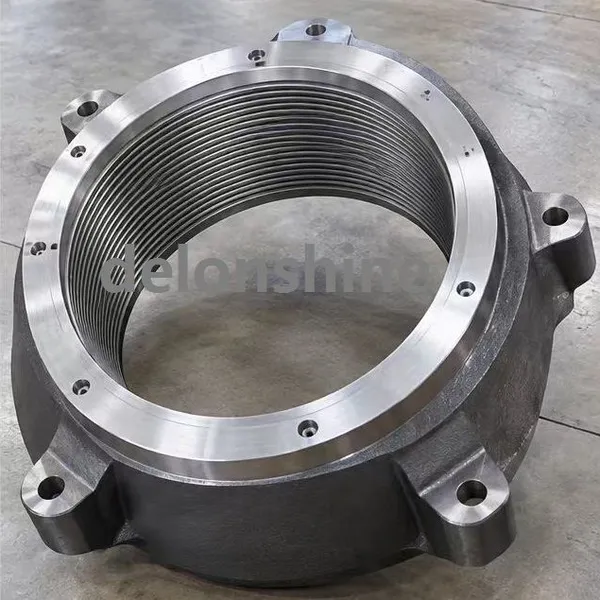 Read More
-
Adjustment Ring Material: Cast Steel Grades and What They Carry
November 6, 2026The adjustment ring material in a cone crusher is almost always a cast steel, and the grade decides how much load the thread can c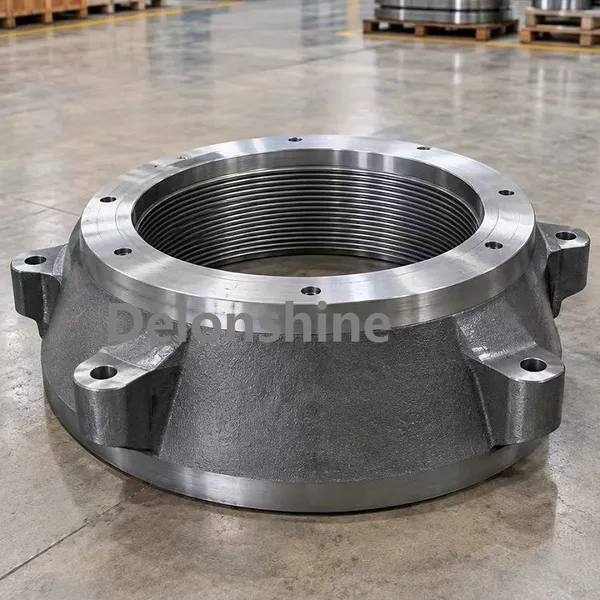 Read More
-
Adjustment Ring Function: How a Cone Crusher Sets Its Close Side
November 6, 2026The adjustment ring function in a cone crusher is to convert a rotation into a vertical movement of the bowl, and that movement is
Read More -
From Sample to Delivery: Our Workflow for Wear Parts Projects
November 4, 2026A wear parts project workflow decides whether a replacement part simply arrives or whether it arrives at the right time, in the ri Read More

Contact Us
Recommended Products
-
 Vertical Mill Reducer Planetary Gear AssemblyNegotiableMOQ: 2 Combos
-
Heavy Duty Mining Equipment Cast HousingNegotiableMOQ: 2 Pieces
-
High Strength Cast Steel Crusher Lifting Beam Heavy Load Mining Equipment Spare PartNegotiableMOQ: 2 Pieces
-
OEM Replacement Mining Spare Parts for Stone Crushing PlantNegotiableMOQ: 2 Pieces
-
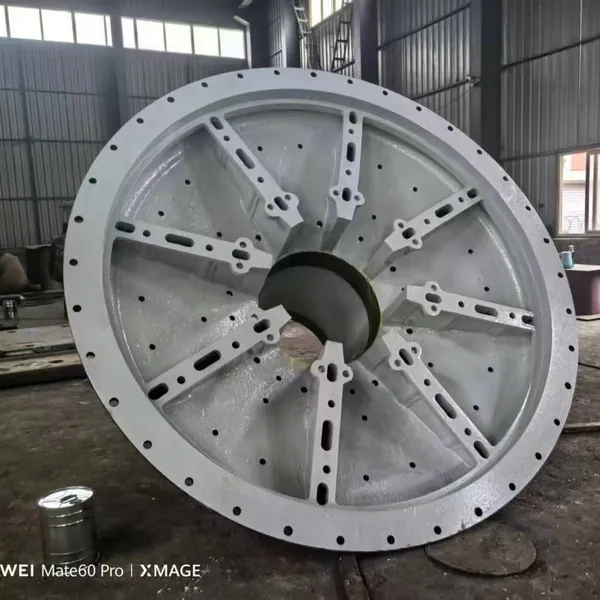
Cast Steel Ball Mill Head for Mineral ProcessingNegotiableMOQ: 2 Pieces
-
Large Diameter Cast Gear for Ore Grinding MillNegotiableMOQ: 2 Pieces
-
Wear Resistant Mining Spare PartsNegotiableMOQ: 2 Pieces
-
Industrial Wet Dry Ball Mill for Mineral ProcessingNegotiableMOQ: 2 Pieces
-
High Wear Resistant Ball Mill Wear Parts Ball Mill Gear Pinion Liner for Mining Processing PlantNegotiableMOQ: 2 Pieces
-
Customized Main Shaft for Cone CrusherNegotiableMOQ: 2 Pieces



-
Ball Mill Head With Flange and Bolt HolesNegotiableMOQ: 2 Pieces
-
Heavy Duty Equipment CasingNegotiableMOQ: 2 Pieces
-
High Manganese Steel Jaw Crusher Fixed & Swing PlatesNegotiableMOQ: 2 Pieces
-
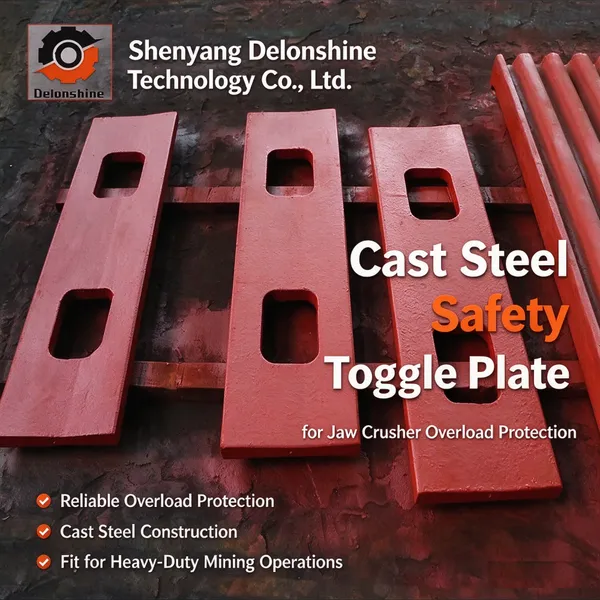
Cast Steel Safety Toggle Plate for Jaw Crusher Overload ProtectionUS$ 10 - 15MOQ: 10 Pieces
-
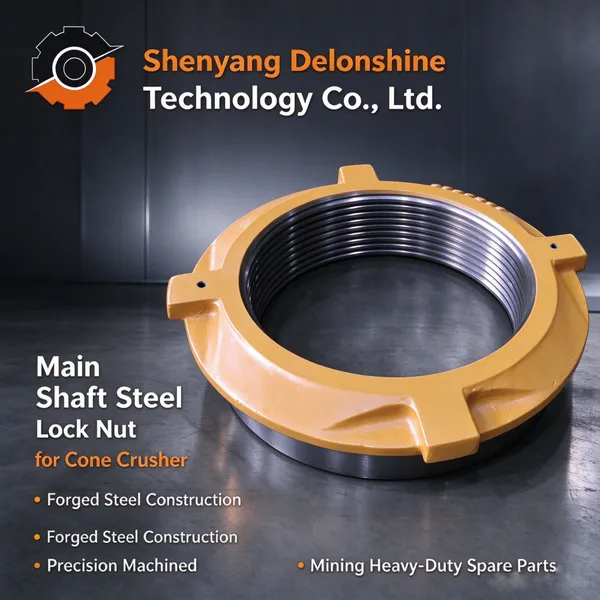
Main Shaft Steel Sleeve Lock Nut for Cone CrusherUS$ 1 - 10MOQ: 1 Piece


-
High Manganese Steel OEM Cone Crusher Bowl Liner According to DrawingsUS$ 10 - 20MOQ: 1 Piece
-
High Precision Mining Equipment End Cover Wear Resistant Crusher End CapUS$ 100 - 26000MOQ: 1 Piece
-
High Manganese Strong Wear and Impact Resistance Steel Alloy RollUS$ 10 - 15MOQ: 1 Piece
-
High Alloy Cast Hammer Head Great Wear & Impact ResistanceUS$ 10 - 15MOQ: 1 Piece
-
Manganese Steel Mining Grate PlateUS$ 10 - 15MOQ: 1 Piece