
 Business License
Machining Capability for Large Nuts, Sleeves and Hubs
A foundry that casts a sleeve lock nut and cannot machine it has delivered half a part, and this article is about the other half.
Shenyang Delonshine Technology Co Ltd machines the large turned parts it supplies, from sleeve lock nuts and shaft sleeves to hubs and end covers, in the same facility where they are cast.
Keeping the two operations under one roof is a deliberate choice, and it removes a step that causes more delay on mining spares than any other.
What follows describes the large machining capability behind those parts, what a heavy machining service can do with a worn component, and how the workshop keeps a large turned part inside its tolerance.
1. Large Machining Capability in One Workshop
Large machining capability means a workshop that can hold a heavy part in a machine and cut it accurately, which is a different problem from machining a small one.
A large turned part weighs several tonnes, so the machine has to lift it, hold it without distortion and turn it at a speed that does not deflect it.
The workpiece also moves under its own weight as it rotates, which is why a heavy part is checked during machining rather than at the end.
A workshop that machines small components alone will usually underestimate the difference.
A part of this class may weigh 5 tonnes or more, and the machine has to hold it without letting the workpiece deflect under its own mass.
Three requirements follow for anyone buying a large turned part.
A machine with the swing and the bed length to take the part in one setting.
A lifting and handling arrangement that does not distort the workpiece when it is moved.
And a measurement method that reaches the part while it is still on the machine, since a heavy part is difficult to move back and forth for checking.
2. Heavy Machining Service for Nuts and Sleeves
A heavy machining service applies to any part where the size rules out a standard approach, and sleeve lock nuts and shaft sleeves sit squarely in that class.
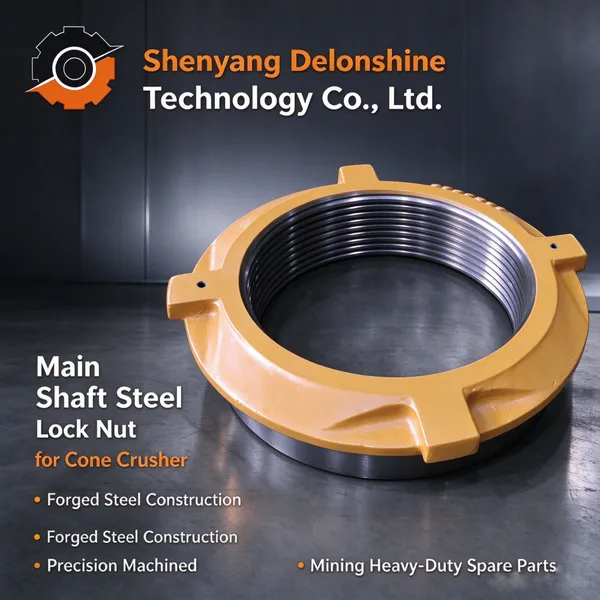
A sleeve lock nut is a turned part with a long internal thread, a shoulder and a hexagon or spanner feature, and every one of those surfaces has to be concentric with the others.
A shaft sleeve is a tube with a bore, a wall and often a shoulder, and its accuracy decides both the fit on the shaft and the wear it will take.
Both parts are usually supplied as castings and finished by machining, which is why the two operations belong together.
Three features are controlled on a sleeve lock nut.
The thread diameter, pitch and class, which decide whether the nut will run on the shaft at all.
The sleeve outside diameter and its concentricity with the thread, so the nut seats without rocking.
And the overall length and the shoulder face, which set the axial position the nut holds.
The thread on a large sleeve nut is normally cut to a class such as 6H, and the bore of a sleeve is held within about 0.05 millimetres of the drawing.
Shenyang Delonshine Technology machines a sleeve lock nut to the shaft drawing rather than to the casting, so the thread and the sleeve are cut to the assembly they will be fitted to.
3. Inside a Shenyang Machining Factory
A Shenyang machining factory sits inside one of China's heavy industrial regions, and that location shapes what a workshop can offer a mining customer.
Shenyang has a long history in machine tools and heavy equipment, so the skills and the supporting supply chain for large machining are present locally.
For a buyer the practical advantage is that heavy castings, machined components and the people who make both are within a short distance of one another.
It also means a repair can be turned around without a part travelling across the country between two workshops.
Three things a buyer should ask about any factory in the region.
Whether the casting and the machining are done in house or split between suppliers.
What the largest part the workshop can machine weighs and measures.
And whether inspection is carried out on the machine or after the part has been unloaded.
Delonshine Technology keeps casting, machining and inspection in one facility, so a query on a shipped part can be answered from its own records rather than from a third party.
4. Large Machining Capability on Boring and Turning
Large machining capability rests on two operations more than any others, which are turning for round parts and boring for internal bores.
Turning a sleeve or a hub uses a lathe with enough swing for the outside diameter and enough rigidity to hold a heavy workpiece against the cutting force.
Boring a large bore, whether in an end cover or a hub, uses a boring machine that can hold the tool steady over a long reach.
The two operations complement each other, and a part like an end cover needs both. A boring machine with a 6 metre travel covers the length of most end covers, while a lathe can hold a part up to about 1200 millimetres in diameter.
The table below sets out the machine types and the range of work each covers.
| Operation | Typical capability | Parts |
|---|---|---|
| Turning | outside diameters up to about 2500 millimetres | sleeves, hubs, nuts |
| Boring | bores up to about 1800 millimetres | end covers, hubs, housings |
| Threading | large internal and external threads | lock nuts, adjustment rings |
| Milling and drilling | bolt patterns on large faces | end covers, flanges |
The figures describe the range a heavy workshop normally covers rather than the limit of any one machine, since the weight and the length of the part decide what can be held as much as the diameter does.
5. A Heavy Machining Service for Repair and Refurbishment
A heavy machining service is also used to bring a worn part back into service, and for a mining customer that is often the more valuable half of the offering.
A shaft that has worn at a sleeve seating can be built up and re-machined rather than replaced.
A hub with a damaged bore can be bored oversize and fitted with a sleeve, which restores the fit without replacing the casting.
And a large nut with a damaged thread can sometimes be re-threaded to an oversize, provided the mating shaft is machined to suit.
Three conditions decide whether a repair is worth doing.
Whether the worn surface is a wear surface, which can be renewed, or a strength surface, which cannot.
Whether the part is available as a replacement at all, since a long lead time changes the calculation.
And whether the repaired part can be inspected to the original requirement, because a repair without an acceptance test is a risk rather than a saving.
6. Why a Shenyang Machining Factory Serves Mining Customers
A Shenyang machining factory serves mining customers because the parts a mine needs are the parts that are awkward to buy, and that is the gap a heavy workshop fills.
A sleeve lock nut for an older crusher may no longer be listed by the original maker.
A hub may need a bore a few tenths different from the standard to suit a shaft that has been repaired.
And a worn component may need renewal within a shutdown window that no standard supply chain can meet.
Three service features answer those cases.
Machining to a customer drawing rather than to a catalogue, so an obsolete part can be reproduced from a sample.
Small batch and one off production, since a mine rarely needs a hundred of a large turned part.
And inspection evidence with the shipment, so the part can be accepted on arrival without a second measurement.
Shenyang Delonshine Technology Co Ltd machines large nuts, sleeves and hubs to customer drawings and samples, and it supplies the inspection report with the shipment so the part can be checked against the requirement it was ordered to.
7. Quality Control in Large Machining Capability
Quality control in large machining capability is mostly about checking the part while it can still be corrected, rather than after it has left the machine.
A heavy part is difficult to reload once it is unloaded, so a defect found after unload costs a second setup as well as a second cut.
Dimensions are therefore taken on the machine, at the stage where the critical surfaces are finished.
The part is then marked and, where it is a fit critical item, checked against the mating component before it is packed.
Four checks cover most large turned parts.
The principal diameters and the bore, measured on the machine.
The thread, gauged rather than measured at a single point, since a thread can be the right size and the wrong form.
The concentricity between the thread and the seating surface, which decides whether the part runs true.
And the material, confirmed against the certificate for the heat the part was cast from.
8. Lead Time and Logistics for a Heavy Machining Service
Lead time for a heavy machining service follows the raw casting rather than the machining, and a buyer who plans around the machine time plans around the wrong thing.
A part with an existing pattern moves into the next production run and then into the machine queue.
A one off part is commonly produced in a batch of 1 to 5 pieces, which keeps the setup cost proportionate to the quantity.
A part with a new pattern adds pattern making and a first article check before a batch is committed.
Machining itself is usually the shorter stage, unless the part needs a specific machine that is already loaded.
Three logistics points matter on a heavy part.
Access at both ends, since a large turned part has to be lifted and secured for the whole journey.
Packing that protects the machined surfaces, because a sleeve lock nut with a damaged thread is scrap on arrival.
And the port, since shipments leave through Dalian, Tianjin, Qingdao or Shanghai depending on the destination and the schedule.
9. Frequently Asked Questions about Large Machining Capability and Heavy Machining Service
9.1 What does large machining capability cover?
Large machining capability covers the turning, boring, threading, milling and drilling of parts that are too heavy or too large for a standard machine. In a workshop serving the mining industry that usually means sleeves, hubs, lock nuts, end covers and similar components weighing several tonnes. The capability is set by the swing and the bed length of the machines and by the lifting and handling arrangements around them. A heavy part also has to be measured on the machine, because reloading it for a check costs a second setup.
9.2 What can a heavy machining service do with a worn part?
A heavy machining service can renew a worn part rather than replace it, which is often the more valuable option to a mine. A shaft worn at a sleeve seating can be built up and re-machined, and a hub with a damaged bore can be bored oversize and fitted with a sleeve. A large nut with a damaged thread can sometimes be re-threaded to an oversize, provided the mating shaft is machined to suit. The limit is reached where the worn surface carries strength rather than wear alone.
9.3 What does a Shenyang machining factory offer mining customers?
A Shenyang machining factory offers mining customers the parts that are awkward to buy, including obsolete fasteners, non standard bores and one off replacements. Work is carried out to a customer drawing or a sample, so a component that is no longer listed by its original maker can be reproduced. Batch sizes suit a mine rather than a production line, since a large turned part is rarely needed in quantity. Inspection evidence is supplied with the shipment so the part can be accepted without a second measurement on site.
9.4 How is quality controlled during heavy machining?
Quality during heavy machining is controlled by checking the part while it is still on the machine, because a heavy workpiece is difficult to reload once it has been unloaded. Principal diameters and bores are measured in place, and the thread is gauged rather than measured at one point, since a thread can be the correct size and the wrong form. Concentricity between the thread and the seating surface is confirmed, as it decides whether the part runs true. The material is checked against the certificate for the heat the casting came from.
Recently Posted
-
From Sample to Delivery: Our Workflow for Wear Parts Projects
November 4, 2026A wear parts project workflow decides whether a replacement part simply arrives or whether it arrives at the right time, in the ri Read More
-
Serving Cone and Jaw Crusher Plants Across Our Export Regions
November 4, 2026Our crusher parts export regions now cover thirteen markets, and each one asks for something slightly different from a wear parts Read More
-
Custom Wear Plate Fabrication for Hoppers and Chutes
November 3, 2026Custom wear plate fabrication starts from a drawing of the wall the plate has to cover rather than from a catalogue of standard si Read More
-
Inside Our Foundry: Manganese Castings for Cone Crusher Liners
November 3, 2026A cone liner casting is decided long before it is poured, in the pattern shop and in the melt, and a buyer who understands the seq Read More

Contact Us
Recommended Products
-
 Vertical Mill Reducer Planetary Gear AssemblyNegotiableMOQ: 2 Combos
-
Heavy Duty Mining Equipment Cast HousingNegotiableMOQ: 2 Pieces
-
High Strength Cast Steel Crusher Lifting Beam Heavy Load Mining Equipment Spare PartNegotiableMOQ: 2 Pieces
-
OEM Replacement Mining Spare Parts for Stone Crushing PlantNegotiableMOQ: 2 Pieces
-
Cast Steel Ball Mill Head for Mineral ProcessingNegotiableMOQ: 2 Pieces
-
Large Diameter Cast Gear for Ore Grinding MillNegotiableMOQ: 2 Pieces
-
Wear Resistant Mining Spare PartsNegotiableMOQ: 2 Pieces
-
Industrial Wet Dry Ball Mill for Mineral ProcessingNegotiableMOQ: 2 Pieces
-
High Wear Resistant Ball Mill Wear Parts Ball Mill Gear Pinion Liner for Mining Processing PlantNegotiableMOQ: 2 Pieces
-
Customized Main Shaft for Cone CrusherNegotiableMOQ: 2 Pieces



-
Ball Mill Head With Flange and Bolt HolesNegotiableMOQ: 2 Pieces
-
Heavy Duty Equipment CasingNegotiableMOQ: 2 Pieces
-
Crusher Wear Parts for Mining MachineryNegotiableMOQ: 2 Pieces
-
High Manganese Steel Jaw Crusher Fixed & Swing PlatesNegotiableMOQ: 2 Pieces
-
Cast Steel Safety Toggle Plate for Jaw Crusher Overload ProtectionUS$ 10 - 15MOQ: 10 Pieces


-
Main Shaft Steel Sleeve Lock Nut for Cone CrusherUS$ 318 - 350MOQ: 1 Piece
-
High Manganese Steel OEM Cone Crusher Bowl Liner According to DrawingsUS$ 800 - 850MOQ: 1 Piece
-
High Precision Mining Equipment End Cover Wear Resistant Crusher End CapUS$ 25000 - 26000MOQ: 1 Piece
-
High Manganese Strong Wear and Impact Resistance Steel Alloy RollUS$ 10 - 15MOQ: 1 Piece
-
High Alloy Cast Hammer Head Great Wear & Impact ResistanceUS$ 10 - 15MOQ: 1 Piece