
 Business License

Through Hardening versus Case Hardening for Crusher Lock Nuts
A through hardened lock nut and a case hardened nut can look identical on the shelf and behave very differently on the machine, and the difference appears at the moment the joint has to hold a high preload.
At a copper plant a set of head nuts was replaced with an alternative supply chosen on price, and three of the new nuts stripped their threads during tightening rather than failing in service.
The parts had a very hard surface over a soft core, which is the wrong combination for a component whose whole duty sits in the thread.
A lock nut heat treatment is therefore not a finish applied after the part is made, but the step that decides what the part can carry.
This article compares through hardening with case hardening for crusher lock nuts, explains what each process does to a thread, and sets out how to write the treatment into a repeat order.
1. Through Hardened Lock Nut and Case Hardened Nut: The Difference
A through hardened lock nut is heat treated so that the hardness reaches the core as well as the surface, while a case hardened nut keeps a soft and tough core beneath a hard outer layer.
Both processes raise the surface hardness, and that is where the similarity ends.
In a through hardened lock nut the whole section carries the same strength, so the thread roots and the sleeve are as strong as the flats on the hexagon.
In a case hardened nut the hard layer is typically 0.5 to 2 millimetres deep, and the steel below it stays relatively soft and ductile.
The table below sets out how the two treatments compare on the properties that decide a nut's behaviour.
| Property | Through hardened lock nut | Case hardened nut |
|---|---|---|
| Hardness depth | full section | outer layer alone |
| Core strength | high throughout | tough but softer |
| Wear at the thread | resists over the full depth | resists until the layer is lost |
| Behaviour under overload | yields before it cracks | layer may crack and spall |
That last row is the reason a cone crusher head nut is normally specified through hardened, since the load path runs straight through the thread rather than along the surface.
2. What a Lock Nut Heat Treatment Has to Achieve
A lock nut heat treatment has to deliver three things at once, and a process that gets one of them right at the expense of the others is a compromise rather than an answer.
It has to make the thread strong enough to carry the preload without yielding.
It has to leave enough toughness that the nut does not crack when it is shocked.
And it has to be repeatable, so that a nut supplied next year behaves like the nut supplied this year.
Four figures on a certificate tell a buyer whether the treatment has done its job.
The core hardness, measured away from the surface rather than at it.
The surface hardness, taken after any coating or plating has been applied.
The depth of any hardened layer, where the process produces one.
And the tempering temperature, since that figure sets the balance between strength and toughness.
3. How Through Hardening Works on a Crusher Lock Nut
Through hardening begins with a steel that can be hardened right through its section, which is why an alloy such as 42CrMo is common for this part.
The nut is heated to a temperature at which the structure becomes austenite, held long enough for the centre to reach that temperature, and then quenched.
The quench has to be fast enough to harden the core, which sets a practical limit on the section size that can be treated this way in a given steel.
A quench that runs too slowly leaves a soft core, and one that is too violent risks a crack at a thread root.
The tempering step that follows is what turns a hard but brittle part into a usable one.
A tempering range of 550 to 650 degrees Celsius is common for a nut of this class, and it brings the hardness down to a level a thread can live with.
A through hardened lock nut for a large crusher is often specified between 30 and 38 HRC after tempering, which resists galling while still surviving a shock.
Because the hardening reaches the centre, a heavy section can be treated without the fall off in core strength that a shallow process would leave.
4. How Case Hardening Builds a Hard Shell on a Nut
Case hardening raises the carbon content at the surface of a low carbon steel and then hardens that layer, leaving the core much as it was.
The process suits a part where the surface has to resist wear while the core has to absorb shock, such as a gear tooth or a pin.
On a nut the hard layer sits on the flanks of the thread and on the bearing face, and the core below remains soft.
That is why a case hardened nut can feel extremely hard under a file while stripping its thread under a load a through hardened nut would shrug off.
Two failure modes follow from that structure.
The hard layer can crack and spall where the load concentrates at a thread root.
And the soft core can yield progressively once the layer above it has been breached.
A supplier who quotes a surface hardness figure alone has not answered the question a crusher application asks.
5. Lock Nut Heat Treatment: Reading a Hardness Certificate
A lock nut heat treatment is verified from a certificate rather than from the feel of the part, and the certificate has a fixed set of fields worth checking.
The grade and the heat number identify the steel the nut was made from.
The core hardness reading shows whether the treatment reached the centre or stopped at the skin.
A case depth figure appears where the process produces a layer, and it should come with the method used to measure it.
And the tempering temperature closes the record, since it links the hardness to the way the part will behave under shock.
A certificate quoting a single hardness number without saying where it was measured answers very little.
Delonshine Technology issues a certificate against each batch it supplies, with the measuring position recorded alongside the figure.
6. Through Hardened Lock Nut versus Case Hardened Nut in Service
In service the two treatments diverge in a way a plant notices across a full campaign rather than on the first day.
A through hardened lock nut holds its preload across many tightening cycles, because the whole thread section resists both the load and the wear that comes with repeated assembly.
A case hardened nut performs well until the layer at the thread is worn or damaged, after which the soft core deforms quickly.
On a crusher, where the nut is released and refitted at every mantle change, the second pattern produces a part that behaves well for a season and then fails without warning.
Three conditions push a plant towards a case hardened nut instead.
Where the nut is small and the duty is light, so hardening a large section is not justified.
Where the surface has to resist fretting more than load, such as a lock nut on a stationary adjustment thread.
And where a soft core is wanted deliberately to protect a shaft, as in a sacrificial design.
7. Where Each Heat Treatment Suits a Crusher
A crusher has several threaded positions, and the heat treatment should follow the duty at each one rather than the habit of the workshop.
The head nut at the top of a cone crusher carries the highest preload and is released most often, so it takes a through hardened lock nut without much argument.
A lock nut on an adjustment thread carries a setting rather than a rotating mass, and its main enemy is fretting and corrosion.
And a sleeve nut on a mill trunnion sits between the two, carrying a steady load with less frequent disturbance.
The table below maps those positions against the treatment that normally suits them.
| Position | Duty | Treatment that suits it |
|---|---|---|
| Cone crusher head | high preload, frequent release | through hardened |
| Adjustment thread | holding a setting | case hardened where fretting dominates |
| Mill trunnion sleeve | steady load | through hardened with a durable thread |
A separating force of several hundred tonnes on a large cone is what the preload has to beat, and a treatment that leaves the thread soft at its root will not beat it for long.
8. Specifying a Lock Nut Heat Treatment for a Repeat Order
Specifying a lock nut heat treatment for a repeat order is a matter of writing down the figures that were verified on the first batch.
The steel grade and the treatment process belong on the drawing rather than in a purchase negotiation.
The hardness range, stated with the position at which it is measured, removes the ambiguity a bare number invites.
And the certificate requirement should name the fields that have to be reported, since a supplier will meet the standard that was actually set.
Four lines cover most of a repeat order.
The grade, such as 42CrMo, written with the standard it is ordered to.
The process, through hardening or case hardening, named explicitly.
The hardness range together with the location of the measurement.
And the thread class, since a treatment that distorts the thread will fail the fit even where the hardness is correct.
A plant ordering 10 to 12 nuts a year will find the record worth keeping after the first replacement, because it removes the guesswork from a repeat order.
Shenyang Delonshine Technology keeps the heat treatment record for a nut against the drawing revision it was made to, so a second order can be compared with the first.
Shenyang Delonshine Technology Co Ltd supplies crusher lock nuts with the certificate fields agreed before the batch is scheduled rather than after it is cast.
Delonshine Technology can also advise on the treatment for a position where the original drawing has been lost.
9. Frequently Asked Questions about Crusher Lock Nut Heat Treatment
9.1 What is the difference between a through hardened lock nut and a case hardened nut?
A through hardened lock nut is treated so that the hardness reaches the centre of the section, while a case hardened nut carries a hard outer layer over a softer core. In a through hardened part the thread roots and the sleeve hold the same strength as the outer surface, which suits a joint loaded to a high preload. In a case hardened part the hard layer is typically 0.5 to 2 millimetres deep, and the core below stays relatively soft. That soft core is what allows a thread to strip under a load a through hardened nut would carry.
9.2 How does lock nut heat treatment affect the thread?
Lock nut heat treatment decides whether a thread can carry a high preload without yielding, and it also sets how the thread behaves each time the nut is removed and refitted. A fully hardened thread resists galling and keeps its form across many tightening cycles. A thread with a hard skin over a soft core holds well until that skin is worn or cracked, after which the core deforms quickly. Distortion from the quench is a separate risk, so gauging the thread after treatment matters as much as the hardness result.
9.3 Which hardening process suits a crusher lock nut?
A crusher lock nut is normally through hardened, because the duty sits in the thread and runs to a high preload that is applied and released many times. Case hardening suits a part whose surface must resist wear while its core absorbs shock, such as a gear tooth or a pin, and that is not the duty of a head nut. There are positions where case hardening is the better answer, such as a light adjustment nut where fretting dominates. Matching the process to the position rather than to the whole machine is what produces a reliable result.
9.4 How should a lock nut heat treatment be specified on a drawing?
A lock nut heat treatment should be specified with the process named, the hardness range stated, and the position at which that hardness is measured. The steel grade and the standard it is ordered to belong on the drawing as well, since the grade sets the hardness the treatment can reach. A case depth figure is needed where a hardened layer is produced, together with the method used to measure it. Adding the thread class closes the specification, because a treatment that distorts the thread fails the part even where the hardness is right.
Recently Posted
-
Work Hardening in Manganese Jaw Crusher Plates
October 19, 2026Work hardening jaw plate behaviour is the reason a manganese casting can arrive soft from the foundry and end up among the hardest Read More
-
Steel Selection for Lock Nuts and Sleeves in Crusher Assemblies
October 19, 2026A 42CrMo lock nut and a plain carbon nut can look identical from the outside, and the difference shows up after a few hundred tigh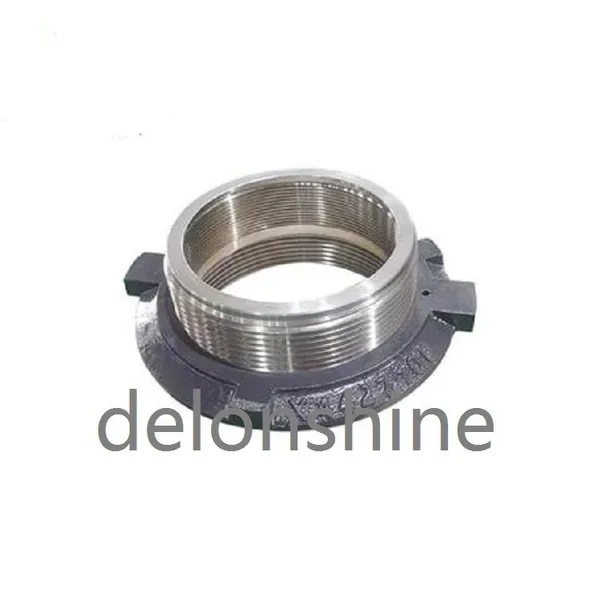 Read More
-
Bolt-On versus Welded Wear Liners for Feed Hoppers
October 16, 2026A bolt on hopper liner and a welded wear plate liner do the same job on the same wall, and the choice between them is decided by t Read More
-
Wear Plate Materials for Feed Hoppers and Chutes
October 16, 2026Choosing between wear plate materials is a decision about the failure mode rather than about hardness, and a plate that wins on a Read More

Contact Us
Recommended Products
-
 Vertical Mill Reducer Planetary Gear AssemblyNegotiableMOQ: 2 Combos
-
High Precision Mining Equipment End Cover Wear Resistant Crusher End CapNegotiableMOQ: 2 Pieces
-
Heavy Duty Mining Equipment Cast HousingNegotiableMOQ: 2 Pieces
-
Mining Parts Concave MantleNegotiableMOQ: 2 Pieces
-
High Strength Cast Steel Crusher Lifting Beam Heavy Load Mining Equipment Spare PartNegotiableMOQ: 2 Pieces
-
OEM Replacement Mining Spare Parts for Stone Crushing PlantNegotiableMOQ: 2 Pieces
-
Cast Steel Ball Mill Head for Mineral ProcessingNegotiableMOQ: 2 Pieces
-
Large Diameter Cast Gear for Ore Grinding MillNegotiableMOQ: 2 Pieces
-
Wear Resistant Mining Spare PartsNegotiableMOQ: 2 Pieces
-
Industrial Wet Dry Ball Mill for Mineral ProcessingNegotiableMOQ: 2 Pieces


-
High Wear Resistant Ball Mill Wear Parts Ball Mill Gear Pinion Liner for Mining Processing PlantNegotiableMOQ: 2 Pieces
-
Heavy Duty Equipment CasingNegotiableMOQ: 2 Pieces
-
Customized Main Shaft for Cone CrusherNegotiableMOQ: 2 Pieces
-
Ball Mill Head With Flange and Bolt HolesNegotiableMOQ: 2 Pieces
-
Heavy Duty Equipment CasingNegotiableMOQ: 2 Pieces


-
Crusher Wear Parts for Mining MachineryNegotiableMOQ: 2 Pieces
-
High Manganese Steel Jaw Crusher Fixed & Swing PlatesNegotiableMOQ: 2 Pieces
-
Cast Steel Safety Toggle Plate for Jaw Crusher Overload ProtectionNegotiableMOQ: 2 Pieces
-
High Manganese Steel Mill LinerNegotiableMOQ: 2 Pieces
-
Main Shaft Steel Sleeve Lock Nut for Cone CrusherNegotiableMOQ: 2 Pieces