
 Business License
Material Selection for Mining Equipment End Cover Castings
A cement plant in North Africa ordered two mill end covers from a low cost foundry and fitted both within the same shutdown.
Both castings met the drawing dimensions and both passed a visual check.
Eighteen months later one of them had a crack running from a rib root toward the trunnion bore, while the other, from a second supplier, was still sound and had just been re-measured with no change.
The difference was not the drawing and not the machining: it was the end cover casting material behind each order.
This article works through the material options for these castings in the order a specification engineer meets them.
It covers cast steel end cover grades, the place a gray iron end cover still holds, the alloy additions and heat treatments that lift fatigue performance, and the information that belongs on a purchase order so the grade arrives as specified.
1. Why Material Selection Drives End Cover Life
An end cover is a structural casting rather than a wear part, so the properties that matter differ from those of a liner or a jaw plate.
Hardness is not the governing figure.
The end cover casting material decides which of those properties the part offers, and careful machining cannot compensate for the wrong choice.
Tensile strength, notch toughness, fatigue strength, weldability, and machinability decide whether the casting survives twenty years of cyclic load and a repair weld at year twelve.
Three questions frame the choice.
The first is how the load arrives: steadily, as in a mill, or cyclically several times per second, as in a crusher.
The second is whether the cover will ever be repaired on site, because a grade that cannot be welded forces a full replacement.
The third is the temperature at which the machine runs, since a cold climate raises the toughness requirement for the same duty.
The table below sets out the material families usually considered for these castings.
| Material family | Typical strength level | Suited duty | Main limitation |
|---|---|---|---|
| Cast carbon steel | 485 to 655 MPa tensile | mill end covers, general structural | needs heat treatment for uniformity |
| Low alloy cast steel | 620 to 830 MPa tensile | large mills, high load covers | higher cost, tighter welding control |
| Quenched and tempered steel | 830 MPa and above | crusher end covers, fatigue duty | repair welding needs care |
| Gray iron | 200 to 350 MPa tensile | small machines, non critical covers | low toughness, difficult to weld |
2. Cast Steel End Cover Grades and What They Suit
A cast steel end cover in a general purpose carbon grade remains the default choice for grinding mills, and for good reason.
Grades written to standards such as ASTM A27 or its regional equivalents combine an adequate tensile level with enough ductility to tolerate an overload without cracking.
They machine predictably, they weld without a large amount of ceremony, and they are available from a wide pool of foundries.
A cast steel end cover is also the easier part to repair once it is in service, which matters on a machine expected to run for decades.
The specification line that matters most is not the grade name but the combination of tensile strength and elongation.
A carbon steel casting at roughly 485 megapascals with 22 percent elongation behaves very differently from one at 655 megapascals with 15 percent elongation, even when both carry the same nominal grade label.
Large covers change the picture slightly.
Once a mill end cover passes roughly 4 metres in diameter, the wall sections thicken and the casting becomes harder to feed and to cool evenly.
At that size a low alloy grade with a small chromium and molybdenum addition, commonly specified near the 620 megapascal level, gives a more uniform structure through the section.
3. Gray Iron End Cover Applications and Limits
A gray iron end cover still has a place, and the place is narrower than it was thirty years ago.
Gray iron damps vibration well, machines easily, holds a machined face with little distortion, and costs less per kilogram than steel.
Those qualities suit small machines, covers that carry a bearing housing rather than a trunnion, and older equipment where the original drawing called for iron.
The limits are structural.
Gray iron has a tensile strength near a quarter of its compressive strength, so a casting loaded in bending behaves much worse than its nominal grade suggests.
Its toughness is low, meaning a cover that flexes under an overload will crack rather than yield.
Repair is the other difficulty, because welding gray iron calls for a specialist procedure and the result rarely matches the parent metal.
The practical rule is straightforward.
Where the cover is loaded mainly in compression and the machine is small, gray iron is a reasonable choice.
Where the cover carries a trunnion on a mill above 2 metres in diameter, ductile iron or cast steel should be considered instead, and Delonshine casts a small number of covers in ductile iron for exactly that reason.
4. Alloy Steel Options for End Cover Castings
Alloy additions and heat treatment work together, and neither one delivers much on its own.
Chromium raises hardenability and wear resistance, molybdenum improves toughness at strength, and nickel lifts low temperature impact performance.
A low alloy chemistry that is cast and then shipped without a proper normalising or quenching and tempering cycle will not develop the structure the chemistry was chosen for.
Three heat treatment routes cover most orders.
Normalising gives a uniform ferrite and pearlite structure and suits covers up to roughly 100 millimetres section thickness.
Normalising plus tempering refines the structure further and is common on large mill covers.
Quenching and tempering produces the highest strength and the strongest fatigue performance, at the cost of a greater risk of distortion on a large asymmetric casting.
Hardness is a convenient check rather than a specification.
A carbon steel cover normally lands between roughly 150 and 200 HB, and an alloy cover between 200 and 260 HB.
A hardness reading far outside that band usually signals a heat treatment fault rather than a chemistry change, and it is worth investigating before the casting is machined.
5. Matching the End Cover Grade to the Duty
The choice between grades becomes much easier once the duty is written down, because the end cover casting material follows from the load rather than from preference.
Mill size, cover diameter, whether the load is steady or reversing, the site climate, and the repair policy together point to one or two sensible options.
A small rod mill cover in a temperate climate rarely justifies anything above a standard carbon grade.
A 5 metre semi-autogenous mill cover with a 25 tonne weight rewards the extra cost of an alloy grade, because the casting is expensive to replace and the foundry risk grows with section size.
A jaw crusher end cover sees millions of load cycles per year, and there a quenched and tempered low alloy grade with a charpy impact requirement belongs on the order.
The table below summarises the usual pairing.
| Application | Typical grade family | Reason |
|---|---|---|
| Rod mill cover up to 2.5 m | cast carbon steel | moderate load, easy repair |
| Ball mill cover 3 to 5 m | cast carbon steel or low alloy | section size, uniform structure |
| SAG mill cover above 5 m | low alloy, normalised and tempered | large sections, high casting risk |
| Jaw or cone crusher cover | quenched and tempered alloy steel | fatigue from reversing load |
| Auxiliary cover, bearing seat | gray iron or ductile iron | compression duty, low cost |
6. Weldability and Repair of End Cover Castings
Weldability is a material property that buyers tend to notice too late.
Carbon equivalent is the figure that predicts it, and a value above roughly 0.45 percent calls for preheat and a controlled cooling rate.
Preheating a cover to between 150 and 200 degrees Celsius before welding, then holding it at temperature through the repair, keeps the heat affected zone from forming a hard and brittle structure.
The repair procedure itself follows a fixed order.
The crack is gouged out to sound metal, the excavation is checked with magnetic particle testing, the joint is welded with a matching consumable, and the whole area receives a post weld heat treatment before it is re-tested.
Skipping the post weld step is the commonest reason a repaired cover cracks again beside the original weld.
A gray iron end cover follows a different path.
Repair usually means a mechanical fix such as a bolted strap or a metal stitching process rather than a conventional weld, and for a cracked cover under load the honest answer is often replacement.
7. Casting Quality and Soundness in End Cover Production
The grade printed on a certificate says nothing about whether the casting was fed properly in the mould.
Shrinkage porosity forms where a thick section meets a thin one, and on an end cover those transitions sit near the trunnion bore and the rib intersections.
A cover with internal porosity can pass every dimensional check and still fail early, because a void acts as a stress raiser under a cyclic load.
The same expectation applies to a gray iron end cover, where an internal void near the bearing seat causes trouble just as reliably.
Feeding and chilling practice on the foundry floor decides the outcome, and the evidence reaches the buyer through testing.
Ultrasonic examination of the heavy sections, magnetic particle testing of the machined faces, and a hardness map across a representative area together show whether the casting is sound.
Wall thickness on a large cover typically runs between 80 and 250 millimetres, and a single void of 10 millimetres at a rib intersection is enough to shorten fatigue life on a crusher cover.
A quarry operator in Eastern Europe received a replacement end cover that arrived with a dimensional report and no non-destructive testing at all.
Ultrasonic examination of the trunnion region on site found an internal indication roughly 40 millimetres below the machined face.
The supplier argued that the casting met the drawing, and technically it did.
Because the purchase order had never required an ultrasonic test, the operator had no contractual ground to reject the part, and the cover was fitted with a repair patch over the area.
Delonshine Technology includes ultrasonic results for the trunnion and flange sections in the standard document pack for castings above 3 metres, because that is where the risk concentrates.
8. Specifying End Cover Casting Material on a Purchase Order
The end cover casting material on a purchase order should carry more than a grade name.
The specification line that works in practice lists the standard, the tensile strength, the yield strength, the elongation, the heat treatment condition, and the hardness range.
To that, add the testing requirements: ultrasonic examination of the heavy sections, magnetic particle testing of the machined faces, and a charpy impact figure where the cover faces a fatigue duty.
Two further items prevent most disputes.
The first is a requirement for the heat number to be marked on the casting and recorded on the certificate, so the material can be traced back to the melt.
The second is a clause stating which features will be inspected and what happens if one falls outside tolerance, because a dimensional non-conformance handled at the works costs far less than one handled at the port.
A concentrator in South America changed its order wording after a grade substitution came to light during a repair weld.
The original certificate named the correct grade, but the heat number marked on the casting did not match it.
Adding a heat number traceability clause and a photograph of the marking to the document pack removed the ambiguity on the following three orders, and Shenyang Delonshine Technology Co Ltd supplies that photograph as a standard attachment on every casting above 3 metres.
9. End Cover Casting Material: Questions Buyers Ask
9.1 Why is a cast steel end cover used instead of a welded fabrication?
A casting wins on stiffness per unit of weight and on the freedom it gives a designer to place ribs and bosses where the load path runs. A welded fabrication of the same outline needs a far thicker plate to reach the same stiffness, and the welds themselves become fatigue initiation points. The counter argument for fabrication is delivery time on a single replacement, since a plate structure can be built in weeks while a pattern and a casting may take longer. For serial production and for large mill covers, the casting is usually the more economical route.
9.2 When is a gray iron end cover still the right choice?
Gray iron suits covers that carry a bearing rather than a trunnion, and machines small enough that bending stress stays modest. Its damping behaviour is genuinely useful on equipment that runs with a rough or pulsating load, and its dimensional stability after machining is better than steel. The grade becomes a poor choice once the cover is loaded in bending, once the part has to be welded during its life, or once the machine grows beyond roughly 2 metres in diameter. Ductile iron is often the better answer in the middle of that range, since it keeps much of the machinability with far higher toughness.
9.3 How does heat treatment change the performance of cast steel end covers?
Heat treatment does not change the chemistry, so it cannot turn a carbon grade into an alloy grade. What it does is remove the as-cast structure, which is coarse and uneven, and replace it with one that is fine and uniform. Normalising alone lifts toughness considerably and is enough for most covers up to about 100 millimetres in section. Quenching and tempering raises strength and fatigue performance further on thinner sections, but the distortion risk on a large asymmetric casting means the process has to be planned with a machining allowance, and a certificate for the heat treatment cycle should accompany the mechanical test result.
9.4 What documents should come with an end cover casting?
A complete pack contains four items: a material certificate naming the grade and heat number, a mechanical test report with tensile and where required impact results, a non-destructive testing report listing the areas examined and the acceptance level, and a dimensional report covering the bolt circle, spigot, seating face flatness and wall thickness. Photographs of the heat number marking and the machined faces add confidence at very little cost. Delonshine issues these as a single file against the heat number, which means a buyer can trace every figure back to one melt and confirm that the end cover casting material on the certificate matches the casting.
Recently Posted
-
Jaw Crusher Plate Replacement Planning and Reorder Points
September 22, 2026A jaw crusher rarely stops because the machine itself has failed. It stops because a consumable part reached the end of its workin Read More
 -
Mining Equipment End Covers in Iron Ore Crushing Lines
September 22, 2026An iron ore plant in Western Australia ran a three stage crushing line for six years before a structural casting failed. The circu Read More
 -
Mining Big Gear Specifications: Module, Pressure Angle and Backlash
September 22, 2026A gold plant in West Africa fitted a replacement girth ring that met every dimension on the drawing and still ran with a heavy kno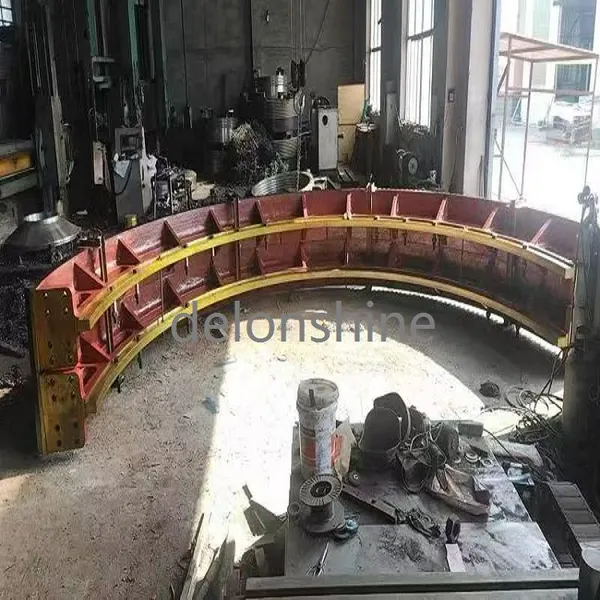 Read More
 -
Buying a Mining Big Gear: Dimensions, Runout and Documents
September 21, 2026A replacement ring is one of the largest single purchases a grinding plant makes, and it is also one of the hardest to return. Fre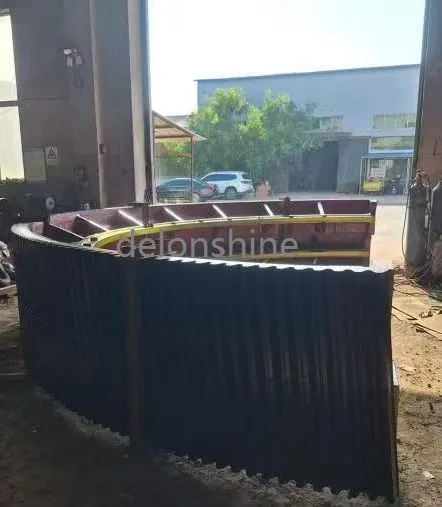 Read More

Contact Us
Recommended Products
-
 Vertical Mill Reducer Planetary Gear AssemblyNegotiableMOQ: 2 Combos
 -
High Precision Mining Equipment End Cover Wear Resistant Crusher End CapNegotiableMOQ: 2 Pieces
-
Heavy Duty Mining Equipment Cast HousingNegotiableMOQ: 2 Pieces
-
Mining Parts Concave MantleNegotiableMOQ: 2 Pieces
-
High Strength Cast Steel Crusher Lifting Beam Heavy Load Mining Equipment Spare PartNegotiableMOQ: 2 Pieces
-
OEM Replacement Mining Spare Parts for Stone Crushing PlantNegotiableMOQ: 2 Pieces
-
Cast Steel Ball Mill Head for Mineral ProcessingNegotiableMOQ: 2 Pieces
-
Large Diameter Cast Gear for Ore Grinding MillNegotiableMOQ: 2 Pieces
-
Wear Resistant Mining Spare PartsNegotiableMOQ: 2 Pieces
-
Industrial Wet Dry Ball Mill for Mineral ProcessingNegotiableMOQ: 2 Pieces


-
High Wear Resistant Ball Mill Wear Parts Ball Mill Gear Pinion Liner for Mining Processing PlantNegotiableMOQ: 2 Pieces
-
Heavy Duty Equipment CasingNegotiableMOQ: 2 Pieces
-
Customized Main Shaft for Cone CrusherNegotiableMOQ: 2 Pieces
-
Ball Mill Head With Flange and Bolt HolesNegotiableMOQ: 2 Pieces
-
Heavy Duty Equipment CasingNegotiableMOQ: 2 Pieces


-
Crusher Wear Parts for Mining MachineryNegotiableMOQ: 2 Pieces
-
High Manganese Steel Jaw Crusher Fixed & Swing PlatesNegotiableMOQ: 2 Pieces
-
Cast Steel Safety Toggle Plate for Jaw Crusher Overload ProtectionNegotiableMOQ: 2 Pieces
-
High Manganese Steel Mill LinerNegotiableMOQ: 2 Pieces
-
Main Shaft Steel Sleeve Lock Nut for Cone CrusherNegotiableMOQ: 2 Pieces